
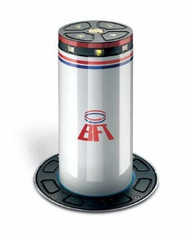
What Are Bollards?
Oct 27th 2017
Increased concerns about security and safety nowadays gave rise to the need for bollards. Security bollards have become an easy source of anti-bump defense anywhere and anytime. Apart from their security functions, bollards are also known for setting visible boundaries of areas or properties, beautifying landscapes, and controlling traffic of vehicles and people alike.
What Bollards Are
A bollard is a vertical post made from different kinds of materials such as plastic, steel, iron, cement, or wood. In the past, bollards were mainly used for mooring large ships at the dock. These days they serve many purposes, however their primary functionality remains up to this date.
Bollards come in different styles. They come in wide range of structures situated in prominent landscapes, around buildings, or on streets. Furthermore, they are also employed outside stadiums, shops, offices, hotels, restaurants, and supermarkets.
Although decorative bollards may come removable, their most common type is permanent. Permanent bollards are usually made of cement and steel or cast-iron. Removable ones on the other hand, could be made of lightweight materials such as plastic. Both kinds of bollards (fixed and removable) have versatile cross-sections. They too however, appear in powder coat, painted, and metallic finishes.
The Primary Use of Bollards
Safety and security is the primary use of bollards, however their applications on traffic and control are also significant. The presence of bollards in certain places works as a guidance for drivers and pedestrians. For example, a series of bollards chained together at a certain place give a clear visual cue that the certain boundary must not to be crossed. It is however up to pedestrians to cooperate as they can go over or under the chains connecting the bollards. When it comes to the use of bollards for directing traffic, they are sometimes made to break away, deflect, or fold on impact.
Security and safety applications of bollards also depend on higher levels of impact resistance. Bollards designed specifically for this purpose are stronger than most other types as they are all about stopping any intentional bumping. In this way, they protect an individual from injury as well as prevent damage to the structure or the wall that is behind these vertical posts.
How to Mount Bollards?
As mentioned before, bollards could either be fixed/permanent or removable. Fixed bollards can be installed in new foundations or mounted into existing concrete. Soil conditions, design threat, and other site-specific factors have to be considered in order to successfully put them in place. Removable and manufactured ones on the other hand, are often designed with their own mounting systems. These standalone mountings may or may not need drilling into existing concrete and anchoring with epoxy.
Because of their high demand and the available technology these days, retractable security bollards are also offered by some manufacturers. Such bollards look like a telescope and can be operated either manually or automatically. Automatic bollards may be hydraulic or electric while the manual ones make use of lift-assistance mechanisms. Sometimes, automatic ones also include a backup power installation for emergency purposes.